


Key Highlights
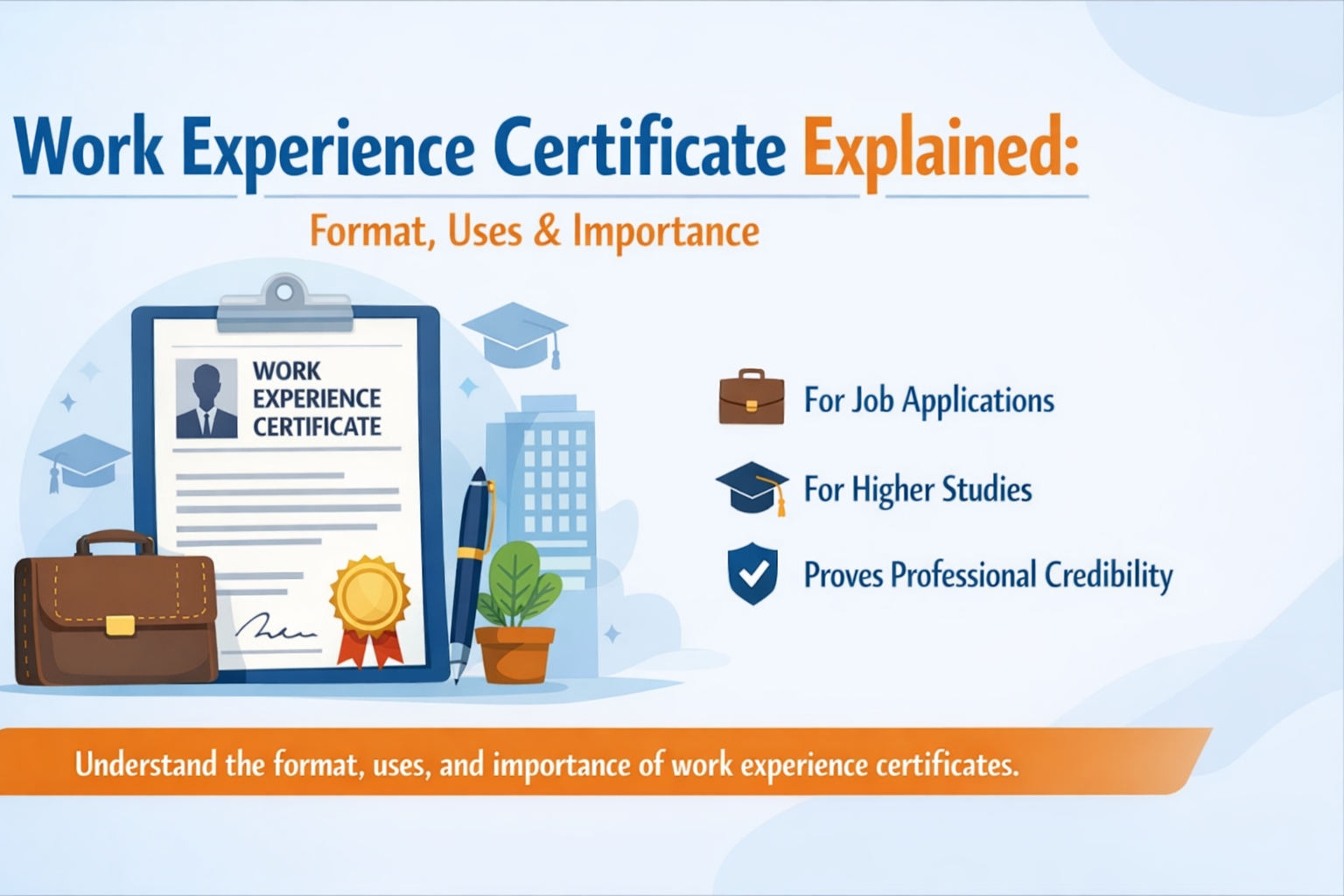
- What a Work Experience Certificate Is: A Work Experience Certificate (WEC) is an official document that verifies an individual’s employment details, including job role, duration, and responsibilities.
- Different Types & Formats: Certificates vary for full-time jobs, internships, and project-based roles. Each format serves different professional and academic needs.
- How to Obtain & Handle Issues: Employees should request the certificate during exit formalities. Errors or refusal can be managed through HR follow-ups or alternative proofs like payslips and offer letters.
Introduction
In today’s professional and academic landscape, documenting your work history is just as important as gaining experience itself. A Work Experience Certificate plays a crucial role in validating your employment and professional contributions. Whether you are applying for a new job, planning higher studies, or preparing for a move abroad, this document serves as formal proof of your professional journey.
You May Also Like


More than just a letter, a work experience certificate confirms where you worked, what role you held, how long you served, and what responsibilities you managed. Issued by your employer, it acts as a credible endorsement of your experience and reliability.
Unlike a recommendation letter, which is opinion-based, a work experience certificate is factual and objective. This makes it a trusted document for employers, universities, and immigration authorities alike.
What Is a Work Experience Certificate?
A Work Experience Certificate is an official document issued by an employer to confirm an employee’s tenure with the organisation. It generally includes:
- Employment duration
- Job title or designation
- Department or role
- Summary of responsibilities
This certificate is widely used for job changes, higher education applications, and visa or immigration processes.
Purpose and Importance of a Work Experience Certificate
For Job Applications
A work experience certificate helps employers verify the authenticity of your professional claims. It reassures hiring managers that you have the experience mentioned in your resume and have performed specific responsibilities in a real work environment.
During background verification, HR teams often rely on this certificate to validate your employment details. Not submitting it when required may delay or negatively impact your job application.
For Higher Education
For postgraduate and professional courses—especially MBA and international programmes—work experience is often a key evaluation factor. A work experience certificate proves that you have applied theoretical knowledge in practical settings.
It strengthens:
- University applications
- Statements of Purpose (SOPs)
- Letters of Recommendation (LORs)
Some programme even require a minimum number of work years, making this certificate essential for eligibility.
For Visa and Immigration
If you are planning to work or settle abroad, a work experience certificate is often mandatory. Immigration authorities use it to assess whether your experience aligns with skilled worker or points-based visa criteria.
It should clearly mention:
- Job title
- Employment dates
- Key responsibilities
- Company letterhead and authorised signature
In some cases, supporting documents like payslips or tax records may also be required.
Essential Components of a Work Experience Certificate
Company Information
- Official company letterhead
- Company name, logo, address, and contact details
- Company stamp or seal (if applicable)
Employee Details
- Full legal name
- Employee ID (if applicable)
- Department and designation
Employment Period and Role
- Exact start and end dates
- Job title(s) held
- Promotions or role changes (if any)
Responsibilities and Achievements
- Key duties handled
- Major contributions or projects
- Notable achievements (optional but valuable)
Authorised Signature
- Signed by HR, manager, or authorised official
- Name and designation of the signatory
Work Experience Certificate Format
A standard work experience certificate should be:
- Printed on official letterhead
- Professionally written
- Clearly structured
- Signed and dated
Below are commonly used formats.
Sample Work Experience Certificate Templates
Standard Full-Time Employment Certificate
[Company Name]
[Company Address]
[Phone Number | Email]
Date: [DD/MM/YYYY]
To Whom It May Concern,
This is to certify that [Employee Name], Employee ID [Employee ID], was employed with our organisation as a [Job Title] from [Start Date] to [End Date].
During this period, [Employee Name] was responsible for [brief description of responsibilities]. They contributed significantly to [projects/achievements] and demonstrated professionalism throughout their tenure.
We wish them success in their future endeavours.
Sincerely,
[Signature]
[Name]
[Designation]
[Company Name]
Internship Experience Certificate
This is to certify that [Intern Name] completed an internship with [Company Name] from [Start Date] to [End Date] in the [Department].
During the internship, they assisted with [tasks/projects] and demonstrated strong learning ability and commitment.
We wish them the very best for their future career.
Project-Based Work Certificate
This is to confirm that [Employee Name] worked with [Company Name] on a project basis as a [Job Title] from [Start Date] to [End Date].
They were responsible for [key tasks] and successfully contributed to [project outcomes].
Types of Work Experience Certificates
Standard Employment Certificate
Issued to full-time employees, confirming long-term employment, responsibilities, and conduct.
Internship Experience Certificate
Given to interns or trainees, highlighting learning outcomes and practical exposure.
Project-Based Work Certificate
Issued for contract or short-term project roles, common in IT, media, design, and construction sectors.
Work Experience Certificate vs Experience Letter
| Feature | Work Experience Certificate | Experience Letter |
| Purpose | Employment verification | Employment + performance |
| Tone | Formal, factual | Slightly personalised |
| Usage | Jobs, visas, education | Job applications |
| Issued | On request | Often automatic |
Work Experience Certificate vs Relieving Letter
| Feature | Work Experience Certificate | Relieving Letter |
| Focus | Work details | Exit confirmation |
| Content | Role, duration, duties | Last working day |
| Usage | Jobs, studies, visas | Job transition |
How to Obtain a Work Experience Certificate
When to Request
- After resignation acceptance
- During exit formalities
- Before applying for jobs, universities, or visas
How to Request
- Write a polite email to HR or your manager
- Mention your name, role, employee ID, and employment period
- Clearly state the purpose (optional)
Tips for an Effective Work Experience Certificate
- Use professional and formal language
- Ensure all details are accurate
- Avoid vague descriptions
- Include brief positive feedback where appropriate
Work Experience Certificates for Study Abroad
Country-Specific Requirements
Different countries and universities may have specific requirements regarding format, stamps, or verification.
Authentication & Attestation
- UK & Ireland: Usually no notarisation required, but documents must be verifiable
- Dubai & UAE: Certificates may require embassy and MOFA attestation
Always check official guidelines before submission.
Common Challenges and Solutions
Errors in the Certificate
Review immediately and request corrections from HR if any discrepancies are found.
Employer Refusal
If a certificate is not issued:
- Use offer letters, payslips, appraisal letters
- Request employment proof from payroll
- Submit a self-declaration with supporting documents
Conclusion
A work experience certificate is more than a formality—it is a verified record of your professional growth. Whether you are aiming for career advancement, higher education, or global opportunities, this document strengthens your credibility and opens doors. Ensuring it is accurate, professional, and complete can make a significant difference in achieving your future goals.
FAQs About Work Experience Certificates
Is a work experience certificate mandatory for all jobs?
No, a work experience certificate is not mandatory for every job, especially entry-level or fresher roles. However, for mid-level, senior positions, regulated industries, background verification, and international jobs, employers often require it as formal proof of your employment history. Its importance increases as your experience level grows.
How long does it take to get a work experience certificate?
The time required depends on company policy.
- Most organisations: 7–15 working days
- During exit formalities: Issued along with relieving documents
- Large organisations or MNCs: May take up to 3–4 weeks
To avoid delays, it’s best to request the certificate before your last working day.
Can I get a certificate for short-term employment?
Yes. You can receive a work experience certificate even if you worked for a few months, on probation, or on a contract/project basis. The certificate will simply mention the actual duration of employment. Short-term experience certificates are commonly accepted for internships, project roles, freelance work, and study abroad applications.
What if my certificate has incorrect details?
If you notice errors such as:
- Incorrect dates
- Wrong job title
- Spelling mistakes
- Missing responsibilities
You should immediately contact HR or your reporting manager and request a corrected version. Always review your certificate carefully before using it for job applications, university submissions, or visa processes.
Is a work experience certificate required for study abroad?
In many cases, yes, especially for:
- MBA and postgraduate programs
- Universities that value professional experience
- Courses with mandatory work experience criteria
A work experience certificate strengthens your application profile, SOP, and visa documentation. Some universities may also ask for additional proof like payslips or employer contact details for verification.
