


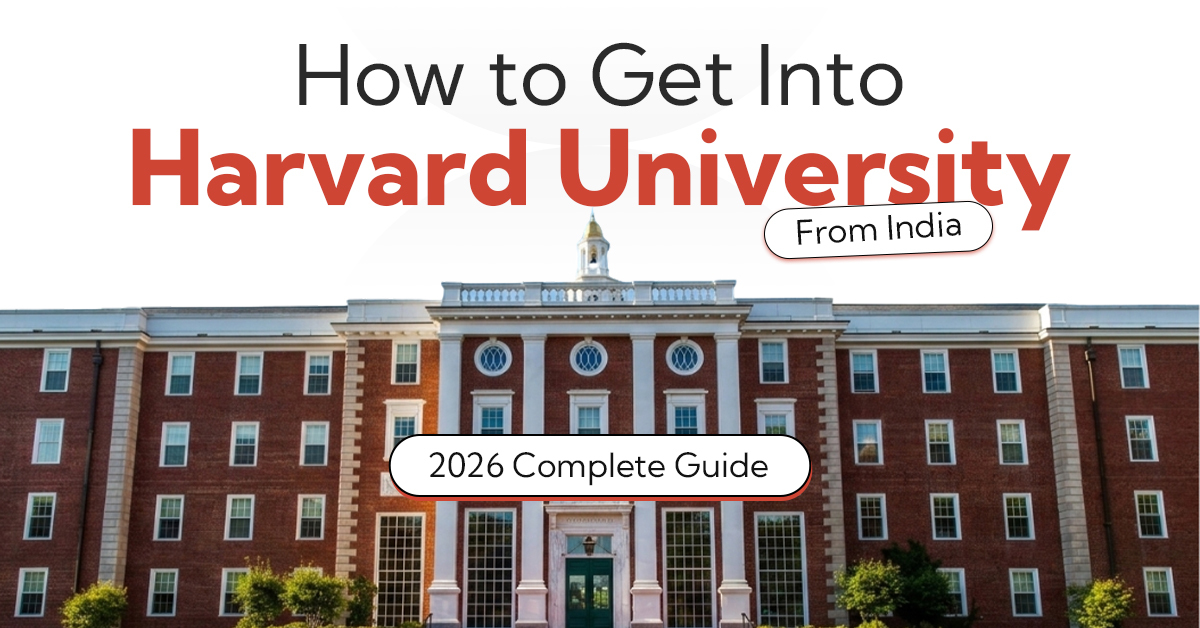
Harvard University is a private Ivy League research university located in Cambridge, Massachusetts, USA. Founded in 1636, it is the oldest university in the United States. Indian students can apply for undergraduate, postgraduate, MBA, medical, and law programs. Admission is highly competitive, with an acceptance rate of approximately 3-4%.
What is Harvard University? (Quick Overview)
You May Also Like
Harvard University is a private Ivy League research university founded in 1636 in Cambridge, Massachusetts — not Boston, as many people mistakenly believe (though Cambridge is part of the greater Boston area). It consistently ranks as the #1 or #2 university in the world and is home to 12 degree-granting schools.
For Indian students, Harvard represents the pinnacle of global education. Its alumni include US Presidents, Nobel laureates, CEOs of Fortune 500 companies, and leading researchers across every field.
Key Facts About Harvard University (2026)
| Detail | Information |
|---|---|
| Founded | 1636 |
| Type | Private, Ivy League |
| Location | Cambridge, Massachusetts, USA (NOT Boston) |
| World Ranking 2026 | #1-2 globally (QS, THE, ARWU) |
| Total Students | ~23,000 |
| International Students | ~27% of total enrollment |
| Acceptance Rate | ~3.6% (Class of 2028) |
| Official Website | harvard.edu |
Is Harvard public or private? Harvard is a private university, which means it relies heavily on tuition fees, endowments, and donations. However, its enormous financial aid program means cost is rarely a barrier for deserving students.
Can Indian Students Apply to Harvard After 12th Grade?
Yes — Indian students can apply to Harvard University directly after completing Class 12 (10+2) for the undergraduate program. You do NOT need a bachelor’s degree to apply for undergraduate admission.
Undergraduate vs Postgraduate — What Can You Apply For?
| Level | Indian Qualification Required | Program Duration |
|---|---|---|
| Undergraduate (UG) | Class 12 / 10+2 (any board) | 4 years |
| Postgraduate (PG/Masters) | Bachelor’s degree (3 or 4 years) | 1–2 years |
| MBA (HBS) | Bachelor’s degree + work experience | 2 years |
| PhD | Bachelor’s or Master’s degree | 4–6 years |
| Medical School (MD) | Bachelor’s degree + MCAT | 4 years |
| Law School (JD/LLM) | Bachelor’s degree (JD) / Law degree (LLM) | 3 years / 1 year |
Harvard University Courses for Indian Students (2026)
1 Undergraduate Programs
Harvard College offers a liberal arts education, allowing students to explore broadly before declaring a concentration (Harvard’s word for ‘major’). Popular choices for Indian students include:
- Computer Science (AB or SB)
- Economics
- Applied Mathematics
- Statistics
- Pre-Medicine (Biology/Chemistry)
- Government & Political Science
- Engineering & Applied Sciences (SB)
- Business/Economics (no formal BBA — Harvard offers Economics)
Note on Harvard BBA: Harvard College does NOT offer a traditional BBA program. Indian students interested in business typically pursue Economics as an undergraduate major, then apply to Harvard Business School (HBS) for an MBA.
2 Postgraduate Programs
Harvard’s graduate schools are world-renowned. Here are the most popular among Indian students:
| School / Program | Degree | Top Indian Interest |
|---|---|---|
| Harvard Business School | MBA | Very High |
| Harvard John A. Paulson School (SEAS) | MS/SM in CS, Data Science, Engineering | Very High |
| Harvard Kennedy School | MPA, MPP | High |
| Harvard Medical School | MD, PhD | High |
| Harvard Law School | JD, LLM | High |
| Harvard Graduate School of Arts & Sciences | MA, PhD in various fields | Medium |
| Harvard T.H. Chan School of Public Health | MPH, DrPH | Medium |
| Harvard Extension School | ALM, ALB (part-time/online) | Medium |
3 Free Online Courses from Harvard
Did you know Harvard offers free online courses that anyone can access? While these are not the same as a degree, they are a great way to learn from Harvard faculty and boost your CV.
- CS50: Introduction to Computer Science (most popular free course in the world)
- CS50P: Introduction to Programming with Python
- Data Science: Machine Learning (edX)
- Justice by Michael Sandel (free on edX)
- HarvardX courses on edX — 100+ free courses across all disciplines
Visit: online-learning.harvard.edu or edX.org/school/harvardx to access free Harvard courses.
Harvard University Admission Requirements for Indian Students (2026)
Harvard has no single minimum requirement. Admission is holistic — they review your academics, test scores, essays, extracurriculars, and character together. Here is what you need to know:
1 Academic Requirements
| Program | Minimum Academic Qualification | Recommended Score |
|---|---|---|
| Undergraduate | Class 12 / 10+2 from any board | 90%+ or Top 5% of class |
| Masters (SEAS) | Bachelor’s degree (CS/Engineering) | CGPA 9.0+/10 or equivalent |
| MBA (HBS) | Bachelor’s degree + 2-5 years work exp | Strong academic record |
| Medical School | Bachelor’s with pre-med requirements | GPA 3.9+ (US scale) |
| Law School (LLM) | Law degree (LLB/BA LLB) | First Class / 75%+ |
2 Standardized Test Scores
| Program | Test Required | Recommended Score |
|---|---|---|
| Undergraduate | SAT or ACT | SAT: 1500-1580 / ACT: 34-36 |
| Masters / PhD | GRE General | Verbal: 160+ / Quant: 167+ |
| MBA (HBS) | GMAT or GRE | GMAT: 730+ / GRE equivalent |
| Medical School (MD) | MCAT | 517+ (97th percentile+) |
| Law School (JD) | LSAT | 174+ (98th percentile+) |
| Law School (LLM) | No LSAT required | Not required for LLM |
3 English Language Proficiency
All international applicants, including Indian students, must demonstrate English proficiency:
| Test | Minimum Score | Recommended Score |
|---|---|---|
| TOEFL iBT | 100 (varies by school) | 110+ |
| IELTS Academic | 7.0 (varies by school) | 7.5+ |
| Duolingo English Test | 125+ | 135+ |
Exception: If you completed your entire undergraduate education in English (as most Indian universities do), some Harvard schools may waive the English test requirement. Check each school’s specific policy.
4 What About a Harvard Entrance Exam?
There is NO separate Harvard entrance exam for Indian students. Harvard does not conduct its own entrance test. Instead, they accept internationally recognised standardised tests (SAT, GRE, GMAT, MCAT, LSAT) as part of the application. This is a common misconception among Indian students.
5 Other Important Requirements
- Letters of Recommendation: 2 teacher recommendations + 1 school counselor (UG) / 3 professional/academic recommendations (PG)
- Statement of Purpose / Personal Essays: Extremely important — often the deciding factor
- Extracurricular Activities: Leadership roles, research, community service, national/international awards
- Resume / CV: For graduate programs
- Portfolio: Required for design/architecture programs
- Interview: By invitation only (not guaranteed)
Harvard Admission Process 2026 — Step by Step
- Research programs and confirm eligibility: Visit harvard.edu and the specific school’s website (e.g., college.harvard.edu for UG, hbs.edu for MBA). Confirm you meet academic and age requirements.
- Prepare for standardized tests (12-18 months in advance): Register for SAT/GRE/GMAT/MCAT/LSAT as applicable. Aim for scores in the top 5-10% nationally. Indian students typically need several months of dedicated preparation.
- Build your profile — academics, activities, and research: Maintain excellent grades. Participate in national-level competitions, research projects, internships, and leadership activities. Unique achievements significantly strengthen your profile.
- Take English proficiency tests: Register for TOEFL or IELTS if required. Most Indian students from English-medium schools score well. Aim for TOEFL 110+ or IELTS 7.5+.
- Request letters of recommendation: Approach 2-3 recommenders (professors, employers, school counselors) at least 3 months in advance. Give them your CV, SOP draft, and context about your achievements.
- Write your essays and Statement of Purpose (SOP): This is critical. Harvard’s admissions essays (especially for UG) assess your character, curiosity, and fit. Spend months drafting, revising, and getting feedback. For graduate schools, your SOP must clearly articulate your research interests and career goals.
- Create your application account: For UG — use the Common Application (commonapp.org) or Coalition Application. For most PG programs — apply directly through each school’s online portal.
- Submit official transcripts and documents: Request certified transcripts from your school/university. Get them attested if required. Submit all certificates, awards, and supporting documents.
- Pay the application fee: Harvard UG application fee is USD 75. Some schools offer fee waivers for students with demonstrated financial need. Apply for a waiver in advance if needed.
- Submit your application before the deadline: Double-check all sections. Proofread essays one final time. Submit early to avoid last-minute technical issues.
- Attend an alumni interview (if invited): Not all applicants are interviewed. If invited, it is a good sign. Prepare to discuss your achievements, motivations, and questions about Harvard.
- Wait for the decision and respond: Decisions are released online. If accepted, you typically have until May 1 to confirm (for UG). Review the financial aid package carefully before accepting.
Harvard University Admission Deadlines 2026
Undergraduate (Harvard College) Deadlines
| Application Round | Deadline | Decision Released |
|---|---|---|
| Restrictive Early Action (REA) | November 1, 2025 | Mid-December 2025 |
| Regular Decision | January 1, 2026 | Late March 2026 |
| Financial Aid Application (CSS Profile) | November 1 (REA) / February 1 (RD) | With admission decision |
Graduate School Deadlines (Typical 2026 Intake)
| School / Program | Application Deadline | Decision Timeline |
|---|---|---|
| Harvard Business School (MBA) | September / January / April (3 rounds) | 6-8 weeks after each round |
| Harvard SEAS (MS/SM) | December 15, 2025 | March-April 2026 |
| Harvard Medical School (MD) | October 15, 2025 (AMCAS) | March 2026 |
| Harvard Law School (JD) | February 1, 2026 | April 2026 |
| Harvard Law School (LLM) | January 15, 2026 | March-April 2026 |
| Harvard Kennedy School (MPA/MPP) | January 2, 2026 | March 2026 |
| Harvard School of Public Health (MPH) | December 1, 2025 | March 2026 |
Important: Deadlines change each year. Always verify current deadlines on each school’s official admissions page before applying.
Harvard University Fees for Indian Students (2026)
Harvard is expensive — but its financial aid program is one of the most generous in the world. Many Indian students graduate with zero debt. Here is a breakdown of costs:
Undergraduate Fees (Harvard College) 2025-26
| Fee Component | Annual Cost (USD) | Approx. Annual Cost (INR) |
|---|---|---|
| Tuition | $59,320 | ~Rs. 49.5 Lakh |
| Room & Board | $21,300 | ~Rs. 17.7 Lakh |
| Personal Expenses | $4,200 | ~Rs. 3.5 Lakh |
| Health Services Fee | $1,226 | ~Rs. 1.0 Lakh |
| Total Estimated Cost | $86,046 | ~Rs. 71.7 Lakh per year |
Postgraduate / Professional School Fees (Approx. 2025-26)
| Program | Annual Tuition (USD) | Annual Tuition (INR Approx.) |
|---|---|---|
| Harvard Business School (MBA) | $73,440 | ~Rs. 61 Lakh |
| Harvard Law School (JD) | $72,450 | ~Rs. 60 Lakh |
| Harvard Medical School (MD) | $67,700 | ~Rs. 56 Lakh |
| Harvard SEAS (MS) | $55,000 – $60,000 | ~Rs. 46-50 Lakh |
| Harvard Kennedy School (MPA) | $57,000 | ~Rs. 47 Lakh |
| Harvard School of Public Health (MPH) | $58,000 | ~Rs. 48 Lakh |
Note: The INR figures above are approximate, based on an exchange rate of USD 1 = INR 83. Exchange rates fluctuate, so always verify current rates. These figures do not include living expenses, health insurance, books, or travel costs, which can add USD 20,000-25,000 per year.
Good news: Harvard’s financial aid for international students is need-blind for undergraduates, meaning your ability to pay does NOT affect your admission decision. If you are admitted, Harvard will meet 100% of your demonstrated financial need.
Harvard University Scholarships for Indian Students (2026)
Harvard University offers generous financial aid and scholarships for Indian students. For undergraduate students, Harvard meets 100% of demonstrated financial need for all admitted students, including international students from India. The average financial aid package for international students is over USD 53,000 per year.
1 Harvard Need-Based Financial Aid (Undergraduate)
- Harvard is need-blind for US citizens — for international students, it is need-aware, but still extremely generous
- Average grant for international students: ~USD 53,000/year (no repayment needed)
- Harvard’s ‘no loan’ policy: Harvard does not include loans in financial aid packages — all aid is grants
- Families earning less than USD 85,000/year may pay nothing at all
- Apply using the CSS Profile (college.harvard.edu) to receive financial aid
2 Harvard Financial Aid for Graduate Students
Graduate financial aid varies significantly by school and program:
- PhD students: Often receive full tuition waivers + a stipend of USD 30,000-40,000/year
- MBA (HBS): Need-based fellowships available; average fellowship is ~USD 26,000/year
- Law School: Grants, fellowships, and Low-Income Protection Plan (LIPP) available
- Medical School: Substantial need-based aid; average aid package covers majority of tuition
3 External Scholarships for Indian Students at Harvard
| Scholarship | For | Amount |
|---|---|---|
| Tata Scholarship (Cornell — not Harvard, but notable) | Indian UG students at Cornell | Up to USD 75,000/year |
| Inlaks Foundation Scholarship | Indian students at top global universities | Up to USD 100,000 total |
| Narotam Sekhsaria Foundation Scholarship | Indian PG students | Up to Rs. 20 Lakh |
| Fulbright-Nehru Fellowships | Indian students for US studies | Full funding |
| Aga Khan Foundation Scholarship | International students from specific regions | Partial/full funding |
| JN Tata Endowment Loan Scholarship | Indian nationals for higher studies abroad | Up to Rs. 10 Lakh |
4 How to Get a Scholarship to Harvard
- Apply Early Action (REA) — early applicants often get better financial consideration
- Submit the CSS Profile as early as possible — even before admission
- Research external scholarships (Inlaks, Fulbright, Tata) and apply simultaneously
- Write exceptional essays — scholarship decisions heavily weigh personal narratives
- Demonstrate financial need clearly and honestly in all forms
5 Harvard Medical School Scholarships
Harvard Medical School offers significant need-based scholarships. More than 50% of HMS students receive aid, with average grants of approximately USD 45,000/year. International students are eligible. Apply through the HMS financial aid office after receiving your admission offer.
Harvard Business School for Indian Students (2026)
Harvard Business School (HBS) is the most prestigious business school in the world and consistently attracts a significant number of Indian applicants each year.
HBS MBA Eligibility for Indian Students
- A bachelor’s degree from any accredited university (Indian degrees are accepted)
- 2-5 years of professional work experience (average incoming class has ~5 years)
- GMAT score: 730+ recommended (median for Class of 2026 was 740)
- GRE is also accepted in lieu of GMAT
- Strong English proficiency (TOEFL/IELTS if applicable)
- Compelling personal essays and recommendations
HBS Application Rounds (2025-26)
| Round | Application Deadline | Decision Date |
|---|---|---|
| Round 1 | September 10, 2025 | December 3, 2025 |
| Round 2 | January 7, 2026 | March 25, 2026 |
| Round 3 (Limited) | April 2, 2026 | May 14, 2026 |
Indian applicants are among the most represented international groups at HBS. However, competition is intense. You need not just a high GMAT score but a compelling story of leadership impact and career trajectory.
Harvard Medical School for Indian Students (2026)
Harvard Medical School (HMS) is one of the most difficult medical schools in the world to get into. Indian students holding an MBBS degree can apply for the MD program or research-focused PhD programs.
- MBBS from an MCI/NMC-recognized Indian university is generally accepted for HMS graduate programs
- For the MD program, you typically need a US bachelor’s degree or equivalent pre-med coursework
- MCAT is required: Target 517+ (97th percentile)
- USMLE Steps 1 and 2 may be required for clinical programs
- Research experience is strongly preferred — many HMS students have published papers
- Application through AMCAS (American Medical College Application Service)
Alternative pathway: Many Indian doctors pursue HMS-affiliated research fellowships or Master’s in Medical Sciences (MMSc) programs, which are more accessible entry points than the full MD.
Harvard Law School for Indian Students (2026)
Harvard Law School (HLS) is the oldest law school in the United States and one of the most prestigious globally. Indian students can apply for both the JD (3-year degree) and LLM (1-year master’s for lawyers already holding a law degree).
JD Program
- Requires a bachelor’s degree (not necessarily in law)
- LSAT score: 174+ recommended (98th percentile)
- Exceptionally competitive: ~11% acceptance rate
LLM Program (Most Common Choice for Indian Lawyers)
- Requires an LLB, BA LLB, or equivalent law degree from India
- No LSAT required for LLM
- Strong academic record: First Class or equivalent
- 2+ years of professional legal experience preferred
- Application deadline: January 15, 2026 (for 2026 intake)
Recognition of Indian law degrees: Harvard accepts law degrees from top Indian law schools (NLS Bangalore, NLUD Delhi, NUJS Kolkata, etc.). Your degree should be from a Bar Council-recognized institution.
Indians at Harvard — Community & Notable Alumni
India is consistently one of the top 5 countries sending students to Harvard University. Indian students are a vibrant and active community on campus.
Indian Student Community at Harvard
- Harvard India Conference: One of the largest student-run conferences at Harvard, focusing on India’s development and business landscape
- Harvard Indian Students Association (HISA): Active cultural, academic, and social events
- South Asian Law Students Association (SALSA) at HLS
- Harvard Desi (informal community network)
Notable Indian Alumni of Harvard
| Name | Program | Notable Achievement |
|---|---|---|
| Amartya Sen | PhD Economics (1959) | Nobel Prize in Economics (1998) |
| Ratan Tata | Harvard Business School (AMP, 1975) | Former Chairman, Tata Group |
| Sundar Pichai | Harvard Business School (not completed — went to Wharton) | CEO, Google/Alphabet |
| Vikram Pandit | Columbia, not Harvard — common confusion | Former CEO, Citigroup |
| Sanjay Gupta | Harvard Medical School | CNN Chief Medical Correspondent |
Note: Always verify alumni claims before sharing. Several public figures are often incorrectly attributed to Harvard. The official Harvard alumni database is the best source.
Harvard University Application Documents Checklist
Undergraduate Application Checklist
- Common Application or Coalition Application account created
- Class 10 and Class 12 marksheets (official/certified)
- School counselor recommendation letter
- Two teacher recommendation letters (subjects relevant to intended major)
- Harvard Writing Supplement essays completed
- SAT/ACT scores sent directly from College Board / ACT
- TOEFL/IELTS scores (if applicable)
- Extracurricular activity list and descriptions
- Application fee paid (USD 75) or fee waiver requested
Graduate School Application Checklist
- Online application form submitted through specific school portal
- Bachelor’s / Master’s degree transcripts (official, attested)
- 3 letters of recommendation (academic or professional)
- Statement of Purpose / Personal Statement (school-specific)
- CV / Resume
- GRE/GMAT/MCAT/LSAT scores (as applicable)
- TOEFL/IELTS scores (if not waived)
- Research publications or portfolio (if applicable)
- Application fee paid (typically USD 85-105)
How to Get Official Transcripts from Indian Universities
- Request from your university’s examination/registrar office — allow 2-4 weeks
- Ask for transcripts in a sealed, stamped envelope (some Harvard schools require this)
- CBSE/ICSE: Request official mark statements from board’s website
- Some schools require WES (World Education Services) evaluation — check specific school requirements
How Hard Is It to Get Into Harvard from India?
Getting into Harvard from India is extraordinarily competitive. The overall acceptance rate for the Class of 2028 was approximately 3.6% — meaning fewer than 4 in every 100 applicants were admitted.
What Harvard Looks for in Indian Applicants
- Academic excellence: Top 1-5% of your class, strong board/competitive exam scores
- Unique personal story: What makes you different from the thousands of other high-achieving Indian applicants?
- Demonstrated impact: Leadership, research, entrepreneurship, social impact — not just participation
- Intellectual curiosity: Evidence you pursue learning beyond the classroom
- Community contribution: How have you contributed to your school, community, or society?
- Authentic voice: Your essays must sound like YOU — not a template or coaching script
Common Reasons Indian Applicants Are Rejected
- Perfect scores but no differentiating factor (too many similar profiles)
- Generic or over-coached application essays
- Only academic achievements with no extracurricular depth
- Applying to too many programs without tailoring applications
- Missing English proficiency test scores or submitting expired scores
The good news: Indian students are admitted to Harvard every year across all programs. With a compelling, authentic application and outstanding achievements, it is absolutely possible.
Frequently Asked Questions (FAQ)
Can I get into Harvard after 12th from India?
Yes. Indian students can apply to Harvard College’s undergraduate program directly after completing Class 12 (10+2). You will need strong grades, SAT/ACT scores, extracurriculars, and essays. There is no separate Harvard entrance exam for Indian students.
What is the minimum percentage required for Harvard?
Harvard has no official minimum percentage. However, successful Indian applicants typically score 90-95%+ in Class 12 or rank in the top 5% of their school. For graduate programs, a CGPA of 9.0+/10 is generally competitive.
Is Harvard University in Boston?
Harvard University is located in Cambridge, Massachusetts — not Boston. Cambridge is a separate city, though it borders Boston and is part of the greater Boston metropolitan area. The Harvard campus is a 30-minute walk from downtown Boston.
Does Harvard offer a BBA program?
Harvard College does NOT offer a BBA. It offers an Economics concentration at the undergraduate level. For a business education, Indian students typically pursue Economics as an undergraduate major and then apply to Harvard Business School (HBS) for an MBA.
What is the total cost of studying at Harvard in Indian Rupees?
The total annual cost for an undergraduate student is approximately USD 86,000 (around Rs. 71-72 Lakh per year as of 2026). For MBA at HBS, it is approximately USD 110,000+ per year including living expenses. However, Harvard’s generous financial aid means many students pay significantly less.
How do I apply for Harvard from India online?
For undergraduate: Apply through the Common Application (commonapp.org) or Coalition Application. For most graduate programs: Apply through each school’s dedicated online portal. All applications are submitted online — there is no paper application.
Is Harvard a public or private university?
Harvard is a private university. It is not funded by the government. However, it has the largest university endowment in the world (over USD 50 billion), which funds its generous financial aid program.
How many Indian students study at Harvard?
Exact numbers are not publicly disclosed per country. However, India is consistently among the top 5 countries of origin for international students at Harvard. The university has a vibrant Indian student community across all its schools and programs.
How long does the Harvard admission process take?
For undergraduate students applying Regular Decision, the process takes approximately 3-4 months from application (January) to decision (late March). For graduate programs, it typically takes 2-4 months. The overall preparation process — including test scores and applications — should begin 12-18 months in advance.
