



Deciding to pursue higher education in Canada is an exciting prospect for many students. It offers a vibrant multicultural environment, world-class education, and excellent career opportunities. However, one common concern students often have is related to study gaps.
You May Also Like


Understanding how study gaps are evaluated by Canadian Designated Learning Institutions (DLIs) and Immigration, Refugees and Citizenship Canada (IRCC) is crucial for planning your educational journey. In this article, we will explore how much gap is accepted for study in Canada and share factors that influence their acceptability.
What is a Study Gap?
A study gap is a break in education that students take between completing one academic qualification and enrolling in the next. It can be a period of time spent working, travelling, volunteering, or pursuing other personal or professional development activities. Study gaps can be anywhere from a few months to a few years.It is important to note that while IRCC has no official rule banning study gaps, individual universities and colleges set their own admission standards and may require students to have specific prerequisite courses or recent academic credits.
Is the Canada gap accepted?
Yes, study gaps are accepted in Canada. IRCC does not impose a fixed maximum gap limit on study permit applicants, and most Canadian universities and colleges accept students with a study gap provided the timeline is fully accounted for and supported by valid documentation.
Institutions and visa officers require clear justification proof for study gaps. It is also important to note that students with long study gaps may not be eligible for certain entrance scholarships or merit-based financial aid programs.
How much gap is accepted for study in Canada?
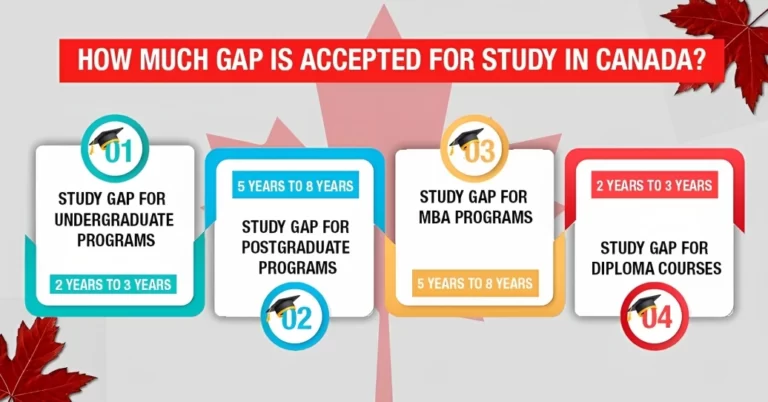
Before embarking on your educational journey in Canada, it’s essential to understand how individual institutions and IRCC view study gaps for different programs. While IRCC sets no statutory cap on study gaps, Canadian universities and colleges apply practical admission benchmarks depending on the level of education you wish to pursue:
Canada gap accepted for undergraduate programs:
For undergraduate programs in Canada, most DLIs typically prefer a study gap of up to 2 years. However, some institutions may allow up to 3 years or more, depending on the circumstances and supporting proof.
Universities and colleges understand that students may take a gap year to explore personal interests, gain practical experience, or engage in volunteer work. However, a longer study gap might raise questions regarding the applicant’s academic preparedness. To strengthen your application, highlight relevant activities or experiences during your study gap to demonstrate personal growth and a commitment to continuous learning.
Study Gap for Postgraduate Programs:
Postgraduate programs in Canada generally accept study gaps of up to 5 years. However, some institutions may allow up to 8 years or more, depending on the circumstances and relevant work history.
It’s crucial to note that some highly competitive programmes or universities may prefer applicants with a more recent academic background. To enhance your chances of admission, showcase any relevant work experience, professional development courses, or research projects you pursued during your study gap. This demonstrates your commitment to the field and ability to apply theoretical knowledge in practical settings.
Study Gap for MBA Programs:
The Canada gap accepted for MBA programs is commonly 5 years or more—in fact, most Canadian MBA programs require 2 to 5+ years of full-time managerial or professional work experience.
Some institutions may allow up to 8–10+ years, depending on the applicant’s career trajectory. It’s important to present a compelling case for your gap years and demonstrate how they have contributed to your personal and professional growth. Highlighting entrepreneurial ventures, leadership roles, or industry certifications from your study gap can significantly strengthen your MBA application.
Study Gap for Diploma Courses:
The commonly accepted study gap for undergraduate diploma programs is 2 to 3 years, while postgraduate diploma/certificate programs frequently accept 5+ years of gap when backed by employment.
Checking with individual institutions and their specific admission requirements is crucial, as well as verifying whether your chosen diploma program meets IRCC’s Post-Graduation Work Permit (PGWP) field-of-study requirements.
Required Documents to Justify Study Gap in Canada
IRCC requires applicants to account for every period of their education, employment, and personal history without unexplained gaps. Providing proper documentation to justify any study gaps in your educational history is essential. Here are some important documents you can gather to justify your study gap:
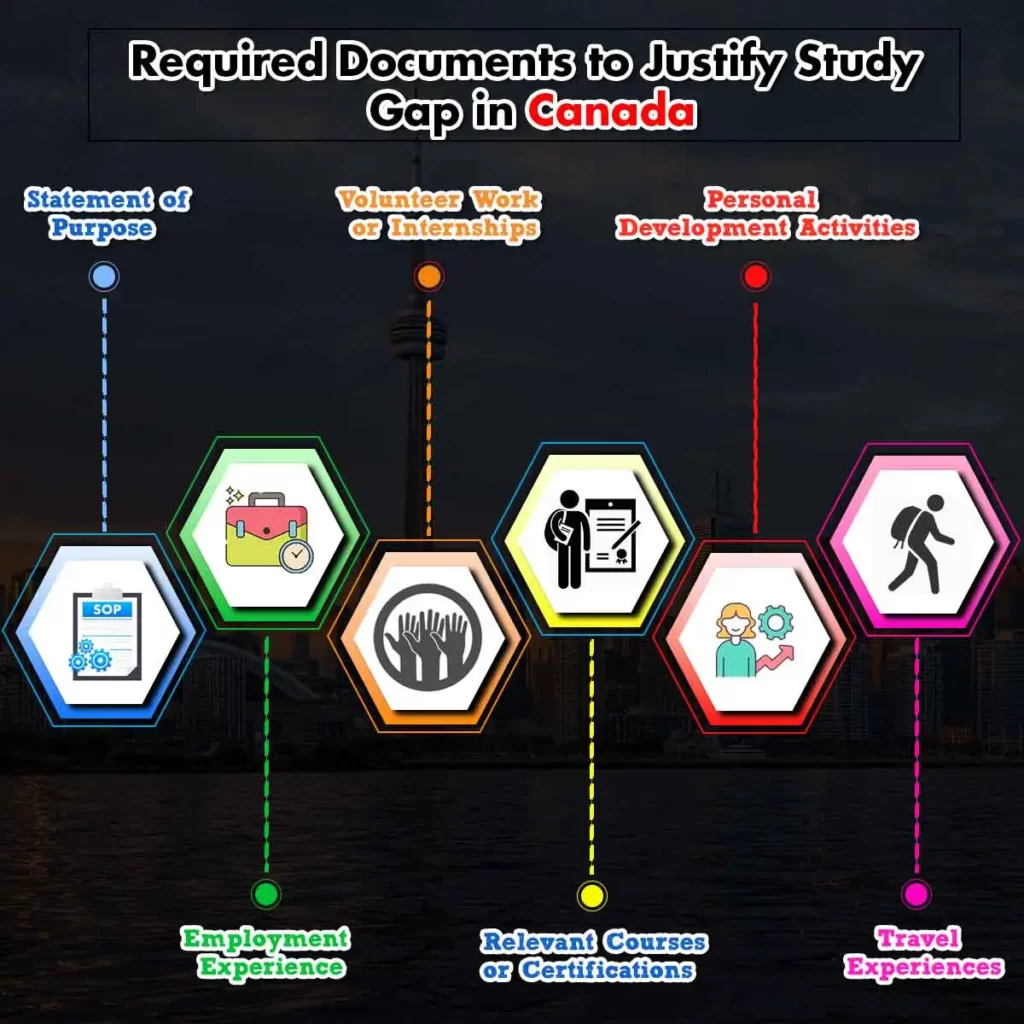
- Statement of Purpose (Letter of Explanation): Compose a well-written statement that explains the reasons for your study gap, such as employment, personal circumstances, health issues, family responsibilities, or skill development. This statement should highlight how the gap period contributed to your personal growth, skill development, or career exploration.
- Employment Experience: If you were employed during the study gap, include employment letters, pay stubs, tax returns (ITRs), or any other relevant documentation that confirms your work experience. Emphasise the skills and knowledge gained during this period and how it aligns with your educational goals
- Volunteer Work or Internships: If you engaged in volunteer work or internships, provide certificates, recommendation letters, or any other evidence that showcases your commitment and contribution during the gap period. Highlight the skills, knowledge, and experiences gained through these activities.
- Relevant Courses or Certifications: If you pursued any courses, certifications, or online learning programs during the study gap, include transcripts, certificates, or completion documents. This demonstrates your continuous learning and dedication to self-improvement during the break.
- Personal Development Activities: If you were involved in personal development activities like attending workshops, seminars, or conferences, provide certificates or proof of participation. Explain how these activities contributed to your personal growth and academic preparedness.
- Medical or Family Records (if applicable): If your break was due to medical treatment or critical family responsibilities, include official hospital records, doctor’s notes, or supporting affidavits.
What Are the Acceptable Reasons for a Study Gap in Canada?
In Canada, having a study gap is generally acceptable as long as you can provide valid and reasonable explanations backed by documentary proof. Some common acceptable reasons for study gaps include:
- Health Issues: If you experienced serious health problems that prevented you from studying during a certain period, this is generally considered a valid reason for a study gap (supported by medical records).
- Personal Reasons: Family issues, challenges, or other significant life events can lead to a study gap.
- Financial Constraints: Taking time off to work and save funds to finance your education is a legitimate reason for a study break.
- Travel or Volunteering: If you took time off to travel, engage in meaningful volunteering work, or participate in an internship relevant to your field of study.
- Career Development: Taking time off to work or gain practical experience in your field can be seen as an opportunity for career growth and skill development.
- Personal Development: Completing competitive exam preparation, language training, or industry certifications can contribute positively to your profile.
- Change in Academic Path: Sometimes, students change their academic direction or transfer to a different institution, leading to a study gap.
It’s important to note that while these are generally acceptable reasons, each institution and program has its own admission criteria for evaluating study gaps. When applying to Canadian educational institutions, check their specific requirements, or you can consult with our counsellor.
How to improve chances of admission with a study gap?
Now that you understand how Canadian institutions and IRCC evaluate study gaps, here is how to improve your chances of admission and present your profile in the best light:
Showcase Relevant Skills and Experiences: During your study gap, engage in activities relevant to your desired field. This could include internships, volunteer work, online courses, or industry certifications. Highlight these experiences in your application to demonstrate your continued commitment to learning and professional development.
Address the Study Gap:
- Use your application’s personal statement or IRCC Letter of Explanation (SOP) to explain the reasons behind your study gap.
- Be honest and concise, outlining any significant personal or professional experiences you gained during that time.
- Emphasize how these experiences have shaped your goals, maturity, and readiness for academic pursuits.
- Highlight Transferable Skills: If your study gap involved work experience or other non-academic endeavours, emphasize the transferable skills you acquired. Universities value these skills and can enhance your application, Whether it’s leadership, teamwork, problem-solving, or adaptability.
- Obtain Strong Letters of Recommendation: Secure letters of recommendation from individuals who can vouch for your potential as a student, even if they are not academic references. This could be a supervisor, mentor, or professional contact who can attest to your qualities and dedication.
- Excel in Standardized Tests: Performing well on standardized tests, such as the SAT, ACT, GRE, or GMAT, can offset concerns about a study gap. Prepare thoroughly for these exams to showcase your academic abilities and readiness for higher education.
- Seek Professional Guidance: Consider seeking assistance from educational consultants or Regulated Canadian Immigration Consultants (RCICs) who specialize in helping students with study gaps.
Other Factors Affecting Admission and Study Permit Approval in Canada
Several other aspects can influence your chances of securing admission and a Canadian study permit:
- Academic Achievements: Canadian universities value academic excellence, so your academic achievements play a significant role. This includes your previous grades, GPA, and any honours or awards you have received.
- Standardized Test Scores: Standardized tests such as the SAT, ACT, GRE, or GMAT are often required for admission to Canadian universities.
- Letters of Recommendation (LOR): Strong letters of recommendation from professors, teachers, or employers can vouch for your academic abilities, work ethic, and potential for success in higher education.
- Statement of Purpose (SOP): Your SOP is your opportunity to articulate your academic and career goals, explain any study gaps, and highlight your motivations for pursuing higher education in Canada. IRCC visa officers assess whether your chosen programme makes logical sense given your prior education and career background.

- Relevant Work Experience: It can be seen as a valuable asset if you have gained relevant work experience during your study gap. Work experience showcases your practical skills, industry knowledge, and dedication to continuous learning.
- Provincial or Territorial Attestation Letter (PAL/TAL) & Financial Proof: For study permit approval, most non-exempt students outside Quebec must submit a PAL/TAL from their province/territory (or a CAQ for Quebec) along with proof of at least CAD 23,448/year for living expenses (effective September 1, 2026) plus first-year tuition and return travel, backed by 6 months of bank statements.
- English Language Proficiency: Proficiency in English (or French) is essential for academic success in Canada. Most institutions require approved language test scores such as IELTS Academic, PTE Academic, TOEFL iBT, or CAEL.
- Interviews or Portfolio Submission: Some universities may conduct student visa interviews or request a portfolio of your work, particularly for creative or specialized programs. These additional assessments provide an opportunity to showcase your skills and abilities.
How can we help you in Study in Canada Journey?
At Transglobal Overseas, our study abroad consultants recognize the challenges associated with understanding and meeting study gap requirements for studying in Canada. That’s why our dedicated team gives their best to provide exceptional support and expert advice to help you accomplish your educational ambitions. Here’s how we can assist you throughout the process:
- Comprehensive Counseling: Our knowledgeable counsellors will assess your educational background, study gap, and future aspirations to provide personalized guidance. We will help you understand Canadian universities and colleges’ specific study gap requirements. And guide you on the best course of action to enhance your chances of admission.
- Student Profile Evaluation: We’ll conduct a thorough assessment of your academic history, taking into account any study gaps. Our team will evaluate your profile honestly, highlighting your strengths and suggesting strategies to address any concerns related to study gaps.
- Course & University Selection: With our extensive knowledge of Canadian universities and colleges, we can help you choose PGWP-eligible institutions more open to accepting students with study gaps.
- Admission & Application Assistance: Our team will assist you in preparing a strong application that effectively showcases your strengths, achievements, and potential. We will help you craft a compelling personal statement and ensure that your application addresses any study gap-related questions positively and convincingly.
- Documentation Support: Our experts will guide you in gathering the necessary documents. Such as transcripts, certificates, and reference letters, ensuring they meet the requirements of Canadian institutions.
- Student Visa Guidance: Our team will guide you through the documentation requirements, financial statements, and other essential aspects to ensure a smooth and successful visa application.
Conclusion
Understanding how much gap is accepted for study in Canada is crucial for international students planning to pursue education in the country. While IRCC sets no official maximum gap limit, each institution sets its own admission criteria, and a moderate or well-documented study gap can be effectively explained in your application. It is important to showcase your educational commitment and highlight relevant experiences or achievements during the study gap period.
