


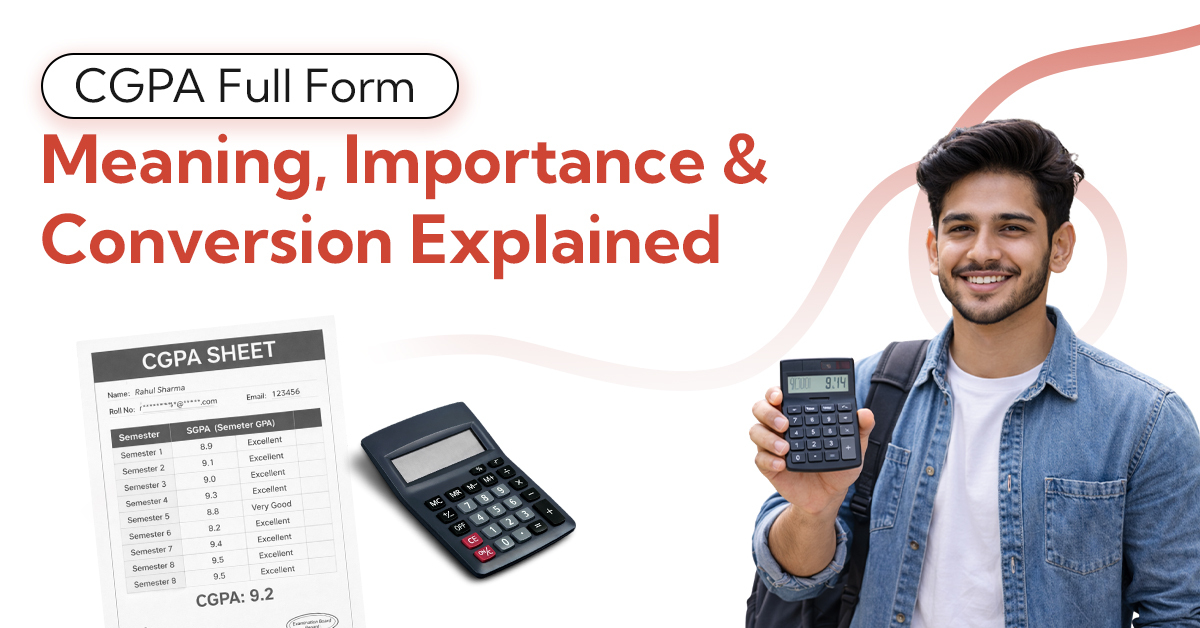
CGPA is a key academic metric used by schools, colleges, universities, and employers to evaluate a student’s overall academic performance. Whether you are applying for higher education, scholarships, campus placements, or study abroad programs, understanding the CGPA full form, meaning, calculation method, and conversion process is essential.
Many students often feel confused about how CGPA differs from percentage, how to convert CGPA to percentage, or how percentages are converted back into CGPA. This guide explains everything in simple terms, with formulas, examples, and real-world usage.
What Is CGPA?
You May Also Like


CGPA, or Cumulative Grade Point Average, is a standardized numerical system used to measure a student’s overall academic performance across multiple semesters or academic years. Instead of evaluating performance based on individual subject marks alone, CGPA calculates the average of grade points earned in all subjects.
The CGPA system promotes consistent learning by reducing the pressure of single-exam performance. Each subject is assigned grade points based on marks obtained, and these grade points are averaged to arrive at the final CGPA.
CGPA is widely used in Indian schools, colleges, universities, and professional courses such as engineering, management, and medicine. It also helps institutions compare student performance across different grading systems.
In simple words, CGPA reflects how well a student has performed academically throughout their course.
What Is the CGPA Full Form?
The CGPA full form is Cumulative Grade Point Average.
- Cumulative – Includes performance across all semesters
- Grade Point – Numerical value assigned to grades
- Average – Mean of all grade points
The CGPA full form in engineering and professional courses remains the same but plays a crucial role in placements, higher studies, and scholarships. Due to its standardized structure, the CGPA system is widely accepted across institutions in India and abroad.
What Does CGPA Stand For and How Is It Used in Indian Universities?
In Indian universities, CGPA is used to:
- Evaluate semester and overall academic performance
- Determine academic rank and honors
- Set eligibility criteria for postgraduate admissions
- Shortlist candidates for placements and internships
Most Indian institutions follow a 10-point CGPA scale, while international universities often use a 4-point scale.
How Is CGPA Calculated in Indian Universities?
Indian universities calculate CGPA by averaging the grade points obtained in all subjects.
CGPA Formula
CGPA = Total Grade Points ÷ Total Number of Subjects
Example
| Subject | Grade Point |
| Mathematics | 8 |
| Physics | 9 |
| Chemistry | 7 |
| English | 8 |
CGPA = (8 + 9 + 7 + 8) ÷ 4 = 8.0
Importance of CGPA
CGPA plays a vital role in shaping a student’s academic and professional journey.
Academic Standing
CGPA determines a student’s academic rank, promotions, and eligibility for advanced courses.
Higher Education & Placements
Universities use CGPA to shortlist candidates for postgraduate programs, while recruiters apply minimum CGPA criteria during campus placements.
Scholarships & Financial Aid
Most merit-based scholarships have minimum CGPA requirements, making it essential for students seeking financial assistance.
Motivation & Consistency
CGPA encourages continuous learning rather than last-minute exam preparation.
Overall, CGPA reflects discipline, dedication, and long-term academic performance.
Where Is CGPA Used?
CGPA plays an important role in multiple academic and professional areas, including:
Indian universities and colleges
Postgraduate admissions such as MBA, MTech, MSc, and MA programs
Study abroad applications
Scholarships and fellowships
Campus placements and job applications
Online and distance education platforms
CGPA vs GPA
Both CGPA and GPA are grading systems, but they differ in scope and application.
GPA (Grade Point Average) measures academic performance for a single semester.
CGPA (Cumulative Grade Point Average) represents overall performance across multiple semesters.
In simple terms, CGPA offers a long-term view of academic consistency, while GPA reflects short-term performance in a specific term.
How to Convert CGPA to Percentage?
CGPA is often converted into percentage format for applications that follow percentage-based evaluation.
General Formula
Percentage = CGPA × Conversion Factor
CBSE CGPA to Percentage Formula
Percentage = CGPA × 9.5
This conversion factor is based on statistical analysis by CBSE.
Example
CGPA 8.0 × 9.5 = 76%
CGPA Conversion on a 10-Point Scale
- CBSE: CGPA × 9.5
- Some universities: CGPA × 10
Always follow your institution’s official conversion method.
CGPA Conversion on a 4-Point Scale
Used mainly by international universities.
Formula
Percentage = (CGPA ÷ 4) × 100
Example
CGPA 3.2 → (3.2 ÷ 4) × 100 = 80%
How to Convert Percentage to CGPA?
Percentage-to-CGPA conversion is commonly required for study abroad and postgraduate applications.
Formula (10-Point Scale)
CGPA = Percentage ÷ 9.5
Example
76% ÷ 9.5 = 8.0 CGPA
Formula (4-Point Scale)
CGPA = (Percentage ÷ 100) × 4
Example
85% → (85 ÷ 100) × 4 = 3.4 CGPA
Common CGPA Ranges and Their Meaning (Out of 10)
- 9.0 – 10.0: Outstanding
- 8.0 – 8.9: Excellent
- 7.0 – 7.9: Very Good
- 6.0 – 6.9: Good
- Below 6.0: Needs Improvement
A CGPA above 8 is considered strong for competitive exams, placements, and international admissions.
Online Tools for CGPA and Percentage Conversion
Many students use:
- CGPA calculators
- University conversion tools
- Study abroad GPA converters
- Academic profile evaluation platforms
These tools help ensure accurate conversion for job and admission applications.
Importance of CGPA for Postgraduate Admissions in India
CGPA is a major criterion for:
- Shortlisting candidates
- Scholarship eligibility
- University cut-off requirements
- Academic ranking
Most postgraduate programs require a minimum CGPA of 6.5–7.0.
Conclusion
Understanding the CGPA full form, meaning, calculation method, and conversion process is essential for students planning their academic and professional future. CGPA provides a fair, standardized, and holistic evaluation of performance over time. By knowing how to convert CGPA to percentage and percentage to CGPA, students can confidently apply for higher education, scholarships, and jobs worldwide. Ultimately, CGPA reflects consistent effort, discipline, and long-term learning rather than short-term exam performance.
FAQs
Q1. What is the CGPA full form?
CGPA full form is Cumulative Grade Point Average.
Q2. What does CGPA mean?
CGPA means the average of grade points obtained across all semesters.
Q3. What is CGPA full form in engineering?
The CGPA full form in engineering is Cumulative Grade Point Average, used for placements and higher studies.
Q4. How do I convert CGPA to percentage?
Multiply CGPA by 9.5 (CBSE method) or follow your university’s guidelines.
Q5. Is CGPA better than percentage?
Yes, CGPA provides a more holistic and consistent evaluation of academic performance.
Q6. What is CGPA and how is it calculated in Indian universities?
CGPA (Cumulative Grade Point Average) is calculated by averaging the grade points obtained in all subjects across multiple semesters. Indian universities assign grade points to marks scored in each subject, and the total grade points are divided by the number of subjects to calculate the final CGPA.
Q7. What does CGPA stand for and how is it used in Indian universities?
CGPA stands for Cumulative Grade Point Average. In Indian universities, it is used to measure overall academic performance, determine academic rankings, eligibility for higher studies, scholarships, and campus placements.
Q8. How do online education platforms calculate CGPA for their courses?
Online education platforms calculate CGPA based on performance in assignments, quizzes, exams, projects, and internal assessments. The grade points from these components are averaged to generate the final CGPA, similar to traditional university evaluation systems.
Q9. How can I calculate CGPA from individual subject grades?
To calculate CGPA from individual subject grades, add the grade points of all subjects and divide the total by the number of subjects.
Formula: CGPA = Total Grade Points ÷ Total Subjects
Q10. Can I convert my CGPA to percentage for job applications?
Yes, CGPA can be converted into percentage for job applications. Most Indian employers accept percentage conversion using the CGPA × 9.5 (CBSE method) or the institution-specified formula. Always follow your university’s official guidelines.
Q11. Are there online tools for converting CGPA to percentage for Indian job applications?
Yes, many online CGPA-to-percentage calculators are available that follow Indian university and CBSE standards. These tools help students convert CGPA accurately for resumes, job applications, and verification purposes.
Q12. Which online tools help calculate CGPA from marks?
Online CGPA calculators, academic score converters, and university-specific grading tools help calculate CGPA from marks. These tools reduce manual errors and save time during academic evaluations.
Q13. What is the importance of CGPA for postgraduate admissions in India?
CGPA is a key criterion for postgraduate admissions in India. Universities use CGPA for shortlisting candidates, setting cut-off scores, awarding scholarships, and evaluating academic consistency for programs like MBA, MTech, MSc, and MA.
Q14. What is the CGPA scale used by popular Indian colleges?
Most Indian colleges and universities use a 10-point CGPA scale, while international institutions commonly follow a 4-point scale. Students should always confirm their institution’s grading system before conversion.
Q15. Which study abroad consultancies advise on academic profile enhancement?
Study abroad consultancies assist students with CGPA evaluation, academic profile improvement, university shortlisting, and application guidance. They help students understand CGPA conversion, GPA equivalence, and admission requirements for international universities.
